Weaponised Scarcity: Policy Options for the EU and Its Gulf Partners on Three Energy Fronts


Europe has spent four years dismantling its dependence on Russian energy, yet 2026 confronted it with a reality at odds with its assumptions. Indeed, Europe had diversified its sources of supply while its risks remained concentrated in the same places. The war with Iran has brought about the near-total closure of the Strait of Hormuz;the Houthis have consolidated their hold over the coastline commanding Babel-Mandeb; and Ukraine's campaign against Russian refineries has deepened a shortage already present in the diesel market. The simultaneity of these three shocks registered directly in prices and stocks. The average price of diesel in the EU reached a record €2.26 a litre on 17 September 2026,[1] while gas storage fell to70% on 21 September, the lowest level recorded on that date in five years.[2]
The gravity of this shock lies in its nature before its scale, for scarcity is now produced deliberately,through strikes on production sites, through the closure of the choke points and bypass routes that carry energy to market, or through the threat of closing them. This paper proposes the concept of weaponised scarcity as a framework for interpreting this shift. It posits that weaponised scarcity redefines energy security for the EU and its Gulf partners and exposes the limits of diversification as pursued by Europe since 2022. In parallel, it opens a narrow window in which EU–Gulf cooperation becomes both a strategic necessity and a realistic possibility. The second EU–GCC summit, to be held in Riyadh on 24October, could become the first opportunity to seize that window.
The Unnamed Risk
The UN Global Risk Report2026, based on a survey of 1,300 stakeholders conducted between February and April, places large-scale war and geopolitical tensions at the forefront of the global risk landscape. Large-scale war rose sixteen places in perceived imminence, the largest shift recorded in the survey.[3] The report nonetheless omits energy supply disruption as a stand-alone item among the 28 risks it measures. Its nearest category, natural resource shortages, confines oil and gas to the logic of depletion and mismanagement, and most respondents placed its impact more than eight years away. The paradox becomes apparent when one recalls that, over those same months, flows through Hormuz were falling from around 20 million barrels a day to an average of 2.7 million.[4]
The consequences of this omission extend beyond methodological classification, since risk frameworks are what define mandates and steer budgets. The report distributes energy across scattered nodes, from war and supply chains to cybersecurity and financial crisis, and leaves its role as the channel connecting these risks outside the scope of analysis. Treating energy as this connecting channel reveals three mutually reinforcing features that distinguish weaponised scarcity from scarcity caused by the depletion of reserves. The first is immediacy, since its effects are measured in days, whereas those of depletion are measured in decades. The second is reversibility by political decision, which turns it into an instrument of negotiation. The third is selectivity. Tehran declared the strait closed to "unfriendly nations" while tankers enjoying its approval continued to sail for China and India.[5] Access to energy there by becomes a privilege granted according to political alignment.
One Pattern Across Three Fronts
The three energy fronts,Ukraine–Russia, the Strait of Hormuz and Bab el-Mandeb, are usually analysed separately. Read together, they show a single pattern, in which production sites, transport routes and their alternatives are targeted at once (Figure 1).
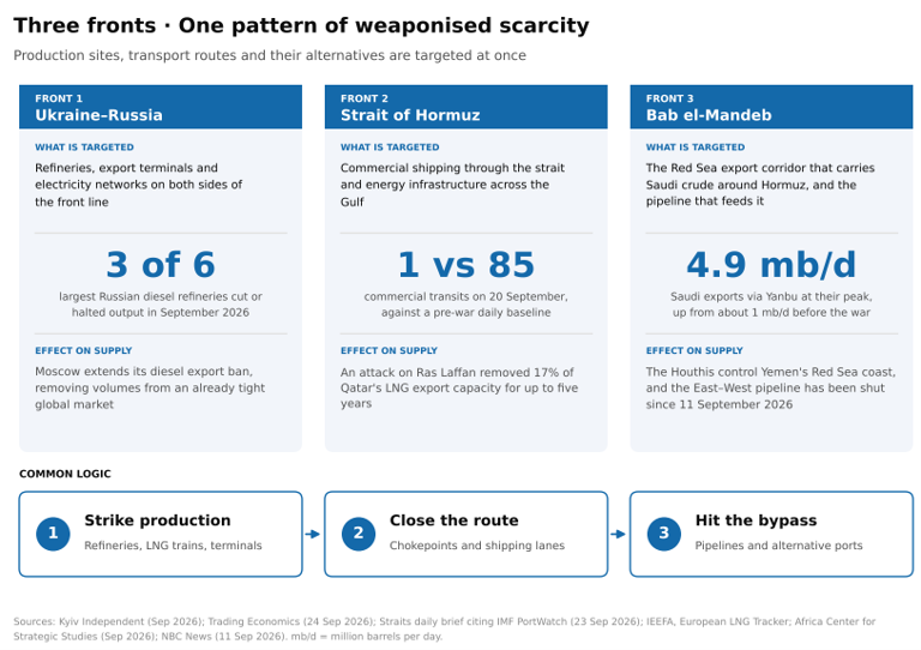
The third front, Bab el-Mandeb, forms the hinge of this logic. Saudi Arabia met the closure of Hormuz by raising its exports through the Red Sea port of Yanbu almost fivefold, from roughly 1 million barrels a day to 4.9 million.[11] In response, the Houthis declared a blockade of Saudi ports and shipping,[12] and drones subsequently struck the pipeline that feeds Yanbu. The bypass thus became a target at the very moment it proved its worth. Fujairah, the UAE’s outlet beyond the strait, had itself come under drone attack as early as March 2026.[13] The three fronts are linked by method more than by geography. Each actor strikes where its adversary’s alternatives are weakest.
THE GEOPOLITICS OF THE THREE FRONTS
Behind the shared method lie distinct political objectives, and each front reshapes a different balance of power. In Hormuz, Tehran is using the strait as its principal bargaining asset in the negotiations with Washington. Selective access rewards the Asian buyers that have kept their distance from the sanctions regime and penalises those aligned with the United States. Gulf producers bear the cost of a confrontation they did not choose, which strengthens their incentive to diversify partners and markets rather than rely on a single security guarantor. In Bab el-Mandeb, the Houthis act as an actor aligned with Iran yet driven by their own calculations. Their blockade of Saudi ports turns the Red Sea from a bypass into a second front, and confirms that a non-state actor can impose costs on a regional power and on global trade at a fraction of the price. On the Russia–Ukraine front, energy has become an instrument of attrition. Kyiv strikes refineries to erode the revenues that finance the war, while Moscow targets the electricity grid to wear down Ukrainian society and test European resolve.
These dynamics redistribute leverage beyond the belligerents. China and India secure preferential access to Gulf supply. The United States consolidates its position as Europe’s dominant LNG supplier, which turns energy into an additional dimension of transatlantic dependence. Russia benefits from higher prices even as its export capacity shrinks. Europe, for its part, absorbs the shock while holding limited military means to shape its course, and its internal cohesion on sanctions and on support for Ukraine comes under pressure each time prices rise.
The economic dimension of the crisis is therefore inseparable from its political core. Energy security has become a question of foreign and security policy, and the partnerships Europe builds with Gulf states now carry strategic weight that goes well beyond trade.
THE LIMITS OF DIVERSIFICATION
After 2022, Europe adopted a strategy built on multiplying its suppliers, and achieved tangible results along this path. Russia’s share of EU gas imports fell from 45% to 12%,[14] and under Regulation (EU) 2026/261, imports of Russian LNG will be banned from the end of 2026 and pipeline gas from autumn 2027.[15] The yardstick of diversification, however, remained confined to the number of suppliers and their geographical origin, while the routes on which they depend, and the likelihood of those routes failing simultaneously, stayed outside the calculation.
Gas. US LNG now accounts for around two-thirds of the EU’s LNG imports,[16] after European purchases of US LNG more than tripled, from 29.8 bcm in 2021 to 99.5 bcm in 2025.[9] Qatar’s share of EU gas imports is limited to about 4%, yet its absence tightens a global market in which Europe relies heavily on spot purchases, competing with other buyers for available cargoes, and in which even long-term contracts are priced against spot prices.[16] Exposure is also unevenly distributed among member states. In 2025, Qatar supplied a third of Italy’s LNG imports, a quarter of Poland’s and 16% of Belgium’s.[9] The EU Agency for the Cooperation of Energy Regulators (ACER) estimates that the Union could require some 56 bcm of spot cargoes should Qatari output remain offline until December 2026,[17] in direct competition with Asian buyers who absorbed close to 90% of the LNG shipped through Hormuz before the war.[18] This coincides with the expiry of the last Russian LNG contracts over the coming winter. Europe is thereby removing one supplier from its market at a moment when a second is offline and a third holds a dominant share.
Oil products. The deepest exposure lies in diesel. Following the 2023 ban on Russian products, the Middle East replaced Russia as Europe's leading diesel supplier, with exports to the continent rising from 18.1 to 22.9 million tonnes between 2022 and 2024.[19] These cargoes transit the Strait of Hormuz and then either the Red Sea or the Cape of Good Hope. The implication is that Europe exchanged exposure to a single supplier for exposure to two chokepoints. The principal alternative, India, has been narrowed by Europe's own sanctions, as the ban on products refined from Russian crude leads European buyers to avoid Indian cargoes.[20] Energy Aspects projects a European jet fuel shortfall of around 510,000 barrels a day in the final quarter of 2026.[21]
Bypass capacity. The Gulf's overland routes remain insufficient to compensate for the strait. The East–West and Habshan–Fujairah pipelines together offer available capacity estimated at between 3.5 and 5.5 million barrels a day, against some 20 million that once crossed Hormuz. Both pipelines have come under attack.[22]
Hence, diversifying suppliers in isolation from routes generates correlated risk. When Russian, Gulf and Red Sea flows are disrupted at once, the alternatives Europe has built are exposed as multiple variants of a single vulnerability. Energy resilience should accordingly be measured first by the capacity of suppliers' routes to fail independently of one another, then by the level of protection afforded to critical nodes and by the speed with which stocks and demand can absorb a shock, and only after by the number of suppliers.
CONVERGING INTERESTS, PERSISTENT CONSTRAINTS
The war has drawn European and Gulf interests closer than all previous institutional frameworks combined. The Gulf states' losses are of volume before they are of price. Output from producers affected by the closure stood 14.4 million barrels a day below pre-war levels in April 2026,[23] and ADNOC expects a full return to normal levels to extend into early 2027, even if the conflict were to end immediately.[24] These states consequently need secure routes, partners beyond Washington and long-term buyers. Europe, for its part, needs the same routes, and its energy investment requirements, which the European Commission puts at around €660 billion a year until 2030, converge with Gulf capital in search of diversification.[25] It was in this context that EU and GCC ministers committed in March 2026 to freedom of navigation in both the Strait of Hormuz and Bab el-Mandeb,[26] and that the GCC Secretary-General, in July of the same year, listed alternative routes and energy cooperation among six priorities for the partnership.[27]
This convergence nonetheless remains bounded by four constraints. The first lies in the limits of European capacity. Operation Aspides deploys 6 warships against a stated requirement of more than 10, while Italy is moving to launch a national mission in place of awaiting an EU decision.[28] The second lies in Gulf hedging, since Asia remains the principal market for Gulf hydrocarbons, and each Gulf state seeks to preserve its relations with China, India and Iran in parallel with building its partnership with Europe. The third concerns divergent assessments of the Iranian threat, both within the Union itself and between the two blocs. The fourth is institutional. The Strategic Partnership with the Gulf, adopted in 2022, has generated more political dialogue than operational mechanisms.
On this basis, timing carries as much weight as substance, and three windows stand out. The first is the Riyadh summit on 24 October 2026.[29] The second is the reopening of Hormuz once the war ends, for which a coalition of more than 50 countries is preparing a defensive mission to restore freedom of navigation.[30] The third is 2027, when the UAE's second Fujairah pipeline is due to enter service[31], and the last Russian pipeline gas is set to leave the European market.
POLICY OPTIONS AND RECOMMENDATIONS
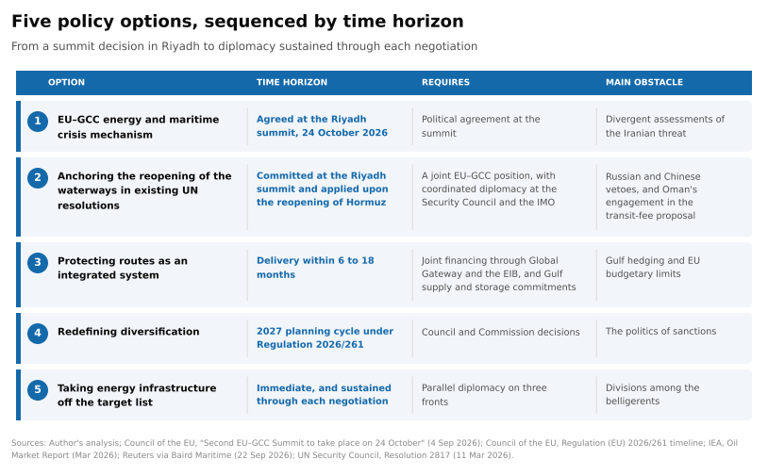
The following options are presented in order of time horizon and of the political investment each requires (Figure 2).
1. An EU–GCC energy and maritime crisis mechanism, agreed at the Riyadh summit. The summit should move beyond declarations towards a standing mechanism for sharing information on maritime threats, coordinating the release of emergency stocks and aligning war-risk insurance arrangements. This option rests on the IEA's assessment that insurance and the physical protection of shipping are preconditions for the resumption of flows.[32] Linking Operation Aspides to Gulf maritime surveillance systems would give Europe's naval presence a reach it would struggle to attain alone.
2. Anchoring the reopening of the waterways in existing UN resolutions. The legal basis for free passage already exists, and the gap lies in its enforcement. Security Council Resolution 2817 of 11 March 2026 condemns any act or threat aimed at closing the Strait of Hormuz or endangering navigation in Bab el-Mandeb,[33] while Resolution 2722 of 2024, renewed until January 2027 by Resolution 2826, keeps Houthi attacks on merchant shipping under the Council’s monthly scrutiny.[34] Both rest on the regime of transit passage under the UN Convention on the Law of the Sea, which guarantees vessels unimpeded passage through international straits and admits no charge levied for passage alone. Tehran has nevertheless collected up to $2 million per transit since March 2026,[35] and seeks to formalise such fees, together with Oman, in any post-war settlement.[36] The EU and the GCC should therefore commit in Riyadh to a common position holding that the reopening of Hormuz and Bab el-Mandeb restores passage for tankers in both directions and under all flags, free of tolls, permits or fees imposed by any party, and that any settlement grants no party a role in vetting or charging shipping. A joint EU–GCC initiative could then ask the UN Secretary-General to extend to Hormuz the reporting mechanism established under Resolution 2722, and ask the International Maritime Organization to set the conditions for the safe return of shipping companies. The 80 states that called for the implementation of Resolution 2817 in September 2026 form a ready coalition for this track.[37] Free and toll-free passage would restore the Gulf’s shortest route to European markets and remove a premium that weaponised scarcity currently imposes on every cargo.
3. Protecting routes as an integrated system, within 6 to 18 months. Bypass routes collapse when they are treated as discrete assets. The Union can therefore help finance air and counter-drone defences for export terminals located beyond the chokepoints, such as Yanbu, Fujairah and Oman’s ports on the Arabian Sea, through Global Gateway and European Investment Bank instruments. In return, Gulf partners would commit to guaranteed supply volumes and to storage arrangements. Gulf-owned strategic stocks held in European ports, modelled on existing Gulf storage arrangements in Asia, represent the most effective means of converting investment into a guarantee of supply.
4. Redefining diversification. The national diversification plans required under Regulation 2026/261 should measure exposure to routes and chokepoints alongside the geographical origin of suppliers, and the Union should press for energy supply disruption to be included as a stand-alone risk in the next round of the UN survey and in its own risk assessments. A more delicate question follows, concerning sanctions that close alternative supply channels, such as the ban on products refined from Russian crude, and the extent to which they require time-limited and verifiable crisis derogations. Balancing the pressure of sanctions against the requirements of supply security calls for an explicit decision, taken openly and with stated reasons.
5. Taking energy infrastructure off the target list. This option rests on a narrow diplomatic track. Its aim is to secure reciprocal commitments from the parties to spare energy facilities and shipping. Three existing channels can carry it: the US–Iran negotiations, the proposed energy truce between Russia and Ukraine, and de-escalation efforts in the Red Sea. Agreements of limited scope remain within the parties’ reach where comprehensive settlements falter, and the EU and Gulf states together carry sufficient economic weight to place such a track on the United Nations agenda.
Conclusion
The UN report asked which risks the world appears least prepared to confront. The events of 2026 add to the answer a risk that, as yet, remains unnamed. Europe has moved beyond stage in which it could measure its energy security by the number of its suppliers,and is now called upon to measure it by the degree to which those suppliers' routes can withstand a crisis independently of one another. Gulf states have reached the same conclusion from the far side of the choke points. Riyadh therefore appears the most fitting place to turn a shared diagnosis into shared-instruments of action.
References
1. IRU,"Diesel prices surpass previous 2026 records", Sep 2026. https://www.iru.org/news-resources/newsroom/diesel-prices-surpass-previous-2026-records
2. Voltstack,EU Gas Storage Tracker (GIE AGSI+ data), 21 Sep 2026. https://voltstack.energy/insights/eu-gas-storage-tracker-winter-2026
3. UnitedNations, Global Risk Report 2026.
4. IEA,"How global oil supplies have readjusted to help fill the huge gap left bythe Strait of Hormuz shock", Jun 2026. https://www.iea.org/commentaries/how-global-oil-supplies-have-readjusted-to-help-fill-the-huge-gap-left-by-the-strait-of-hormuz-shock
5. "2026Strait of Hormuz campaign", Wikipedia. https://en.wikipedia.org/wiki/2026_Strait_of_Hormuz_campaign
6. KyivIndependent, Sep 2026. https://kyivindependent.com/ukrainian-forces-strike-russian-oil-refinery-in-samara-oblast-in-overnight-drone-attack/
7. TradingEconomics, Gasoline, 24 Sep 2026. https://tradingeconomics.com/commodity/gasoline
8. Straits,Hormuz daily brief, 23 Sep 2026. https://straits.live/briefs/2026-09-23
9. IEEFA,European LNG Tracker. https://ieefa.org/european-lng-tracker
10. NBCNews, 11 Sep 2026. https://www.nbcnews.com/world/middle-east/houthis-control-bab-el-mandeb-yemen-red-sea-saudi-iran-war-oil-rcna597186
11. AfricaCenter for Strategic Studies, Sep 2026. https://africacenter.org/spotlight/2026-houthi-red-sea-threats/
12. CNBC,22 Jul 2026. https://www.cnbc.com/2026/07/22/houthis-red-sea-bab-el-mandeb-saudi-oil-iran.html
13. Malay Mail (Reuters), 18 Mar 2026. https://www.malaymail.com/news/money/2026/03/18/drone-strikes-expose-reliance-on-uaes-fujairah-port-as-a-critical-middle-east-oil-bypass/213052
14. EuropeanParliament resolution of 17 December 2025 on phasing out Russian natural gasimports. https://en.wikipedia.org/wiki/European_Parliament_resolution_of_17_December_2025_on_phasing_out_Russian_natural_gas_imports
15. Councilof the EU, Timeline: ending Russian energy imports. https://www.consilium.europa.eu/en/policies/ending-russian-energy-imports/timeline-ending-russian-energy-imports/
16. Bruegel,"How Europe should respond to the Iran gas shock", 2026. https://www.bruegel.org/analysis/how-europe-should-respond-iran-gas-shock-and-how-it-shouldnt
17. ACER,"Middle East impact: filling EU gas storage will be expensive", 2026.https://www.acer.europa.eu/news/middle-east-impact-filling-eu-gas-storage-will-be-expensive-competitive-lng-market
18. IEA,The Middle East and Global Energy Markets, Aug 2026. https://www.iea.org/topics/the-middle-east-and-global-energy-markets
19. S&PGlobal Commodity Insights, "European diesel trade map redrawn". https://www.spglobal.com/commodity-insights/en/news-research/latest-news/refined-products/090225-european-diesel-trade-map-redrawn-following-russia-ukraine-conflict
20. Kpler,"Where can Europe secure jet fuel to replace the Mideast Gulf?", 11Mar 2026. https://www.kpler.com/blog/markets-in-motion-where-can-europe-secure-jet-fuel-to-replace-the-mideast-gulf
21. GlobalPetroleum Advisors, citing Energy Aspects, Sep 2026. https://globalpetroleumadvisor.com/europes-fuel-crisis-is-spreading-from-diesel-to-jet-fuel/
22. CNBC, 23 Apr 2026. https://www.cnbc.com/2026/04/23/strait-hormuz-closure-alternative-routes-middle-east-oil-gas-pipelines.html
23. IEA,Oil Market Report, May 2026. https://www.iea.org/reports/oil-market-report-may-2026
24. CNBC,20 May 2026. https://www.cnbc.com/2026/05/20/uae-pipeline-strait-hormuz-iran-war-oil.html
25. ArabNews, 28 Sep 2026. https://www.arabnews.com/business/riyadh-summit-puts-gulf-europe-investment-in-ai-and-technology-in-focus-3003571
26. Councilof the EU, Joint statement by GCC–EU Ministers, 5 Mar 2026. https://www.consilium.europa.eu/en/press/press-releases/2026/03/05/joint-statement-by-gcc-eu-ministers-meeting-on-recent-developments-in-the-middle-east-iran-s-attacks-against-gcc-states/
27. GCCSecretariat General, 13 Jul 2026. https://www.gcc-sg.org/en/MediaCenter/News/Pages/news-2026-7-13-4.aspx
28. BairdMaritime (Reuters), 22 Sep 2026. https://www.bairdmaritime.com/security/naval/eu-red-sea-mission-needs-over-10-warships-members-urged-to-contribute
29. Councilof the EU, "Second EU–GCC Summit to take place on 24 October", 4 Sep2026. https://www.consilium.europa.eu/en/press/press-releases/2026/09/04/second-eu-gcc-summit-to-take-place-on-24-october-in-saudi-arabia/
30. EuropeanCouncil, informal meeting of 23–24 April 2026. https://www.consilium.europa.eu/en/meetings/european-council/2026/04/23-24/
31. AlJazeera, 15 May 2026. https://www.aljazeera.com/news/2026/5/15/uae-to-accelerate-oil-pipeline-project-to-bypass-hormuz
32. IEA,Oil Market Report, March 2026. https://www.iea.org/reports/oil-market-report-march-2026
33. UNSecurity Council, Resolution 2817 (2026), 11 Mar 2026. https://www.iranwatch.org/sites/default/files/un_security_council_resolution_2817_2026.pdf
34. SecurityCouncil Report, “The Red Sea: Vote on a Draft Resolution”, 12 Jul 2026. https://www.securitycouncilreport.org/whatsinblue/2026/07/the-red-sea-vote-on-a-draft-resolution.php
35. gCaptain(Bloomberg), “Iran Imposes $2M ‘Toll’ on Ships Transiting Strait of Hormuz”, 24Mar 2026. https://gcaptain.com/iran-imposes-2m-toll-on-ships-transiting-strait-of-hormuz/
36. IDNFinancials (Reuters), “Iran’s ambassador in Moscow says Hormuz to reopen butwith transit fee”, 8 Jun 2026. https://www.idnfinancials.com/news/64538/irans-ambassador-in-moscow-says-hormuz-to-reopen-but-with-transit-fee
37. HellenicShipping News, “80 countries sign joint statement calling for reopening ofStrait of Hormuz”, Sep 2026. https://hellenicshippingnews.com/80-countries-sign-joint-statement-calling-for-reopening-of-strait-of-hormuz
Other Researches