Intersecting Ballots: The Israeli, Palestinian and US Elections and the Future of the Peace Process

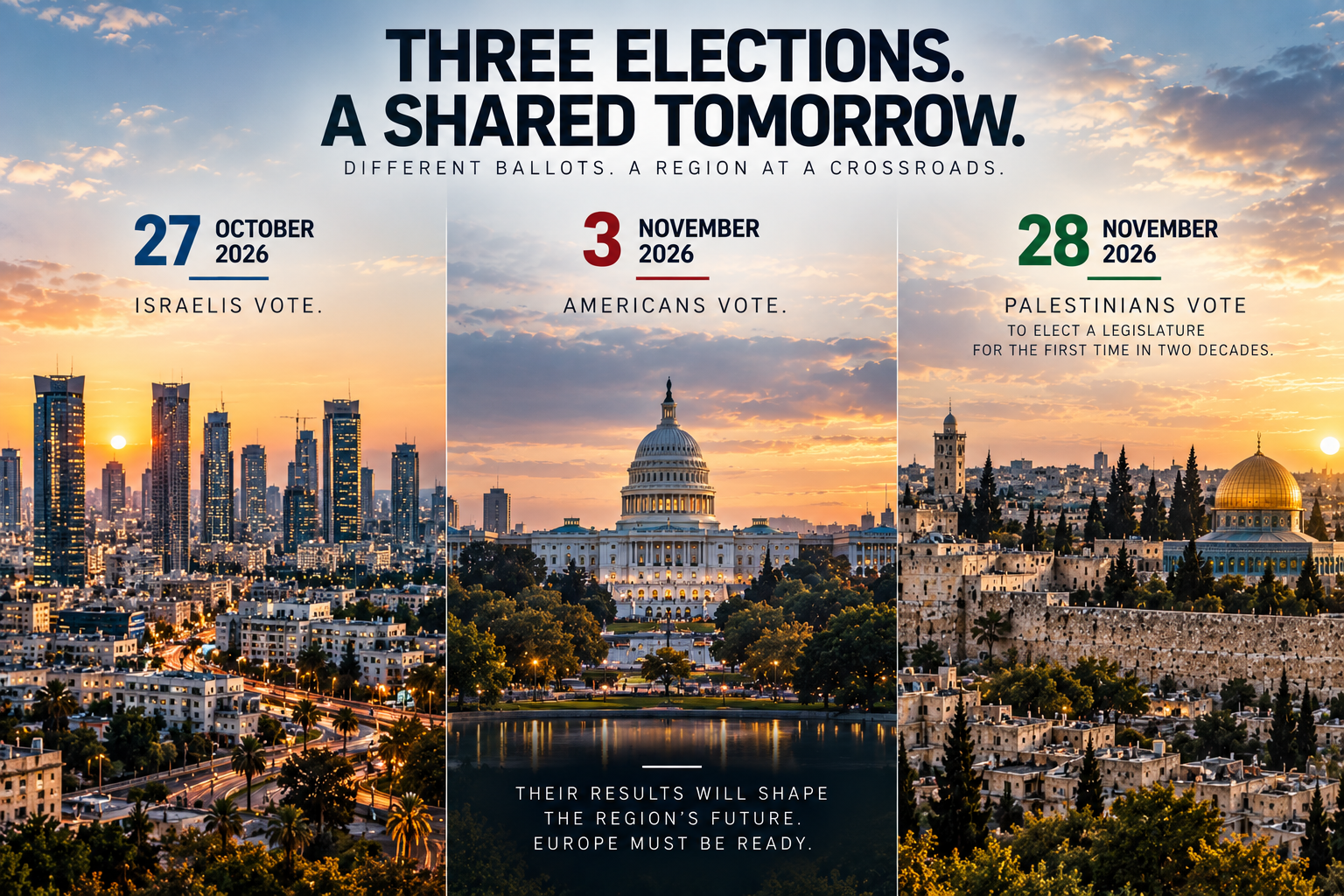
Three elections fall within a single window this autumn. Israelis vote on 27 October, Americans on 3 November and Palestinians on 28 November to elect a legislature for the first time in two decades. Peace is central to none of them, yet the interaction of their results will shape how the conflict is governed through 2027 and beyond.
Each vote is a test of legitimacy before it is a milestone in any peace process. Israel is settling the identity of its state and the reach of its control over the land. Palestinians are trying to recover a representative mandate that has been eroding since 2006. The United States is redefining the room for manoeuvre of the conflict's external patron. For the European Union, the question is not which result would be preferable. It is how to hold a position that keeps its force whatever the outcome, as predictability falls and the scope for irreversible decisions widens.
From Settlement to Administration
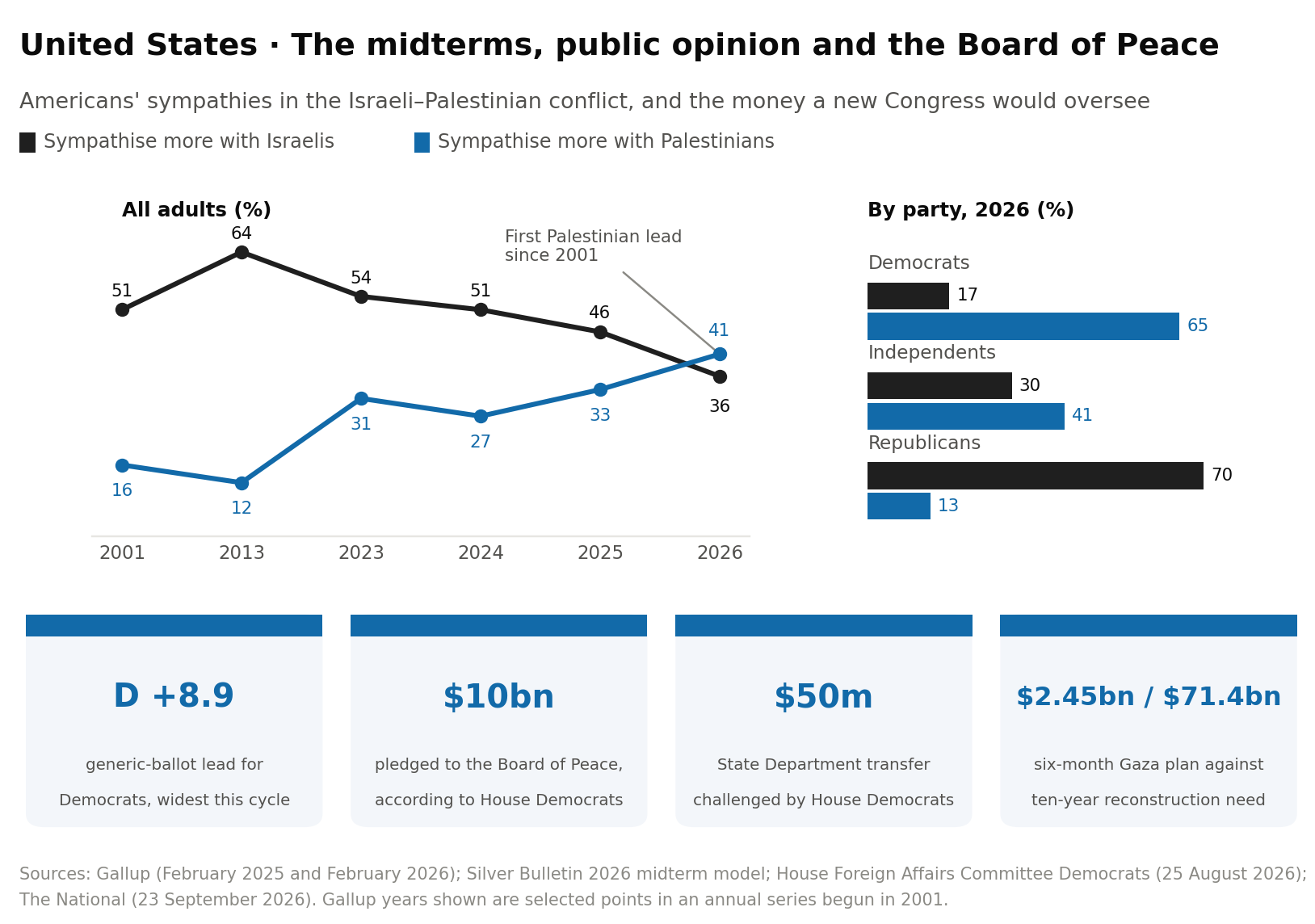
Since the ceasefire of October 2025, the diplomatic centre of gravity has shifted from a final settlement to the management of the post-war order. Gaza is to be run in the interim by a Palestinian technocratic committee under the US-chaired Board of Peace, which on 23 September tabled a six-month reconstruction plan worth $2.45 billion against an estimated need of some $71.4 billion over a decade.[1] The distance between the two figures mirrors a deeper gap between administrative ambition and an absent political horizon.
The three elections are the first moment since the October 2025 ceasefire at which the legitimacy underpinning any future process is being recast. They will decide whether the logic of administration becomes entrenched or whether an opening appears for politics to return. That logic is already at work. In Gaza, the Board of Peace and the technocratic committee set reconstruction priorities, security arrangements and the pace of any return by the Palestinian Authority, yet neither holds a mandate to decide who will ultimately govern the territory. In the West Bank, control over land advances through planning permits, settlement approvals and administrative measures, without any declared decision on annexation. Representation, for its part, is shaped by eligibility rules in the Knesset and the Legislative Council alike. Sovereignty, borders and representation are thus being settled in practice while remaining formally open, and each administrative step narrows the options left to any future negotiation.
Palestine: Contested Representation
The Palestinian vote follows twenty years without a legislative mandate, and of rule by decree since the council was dissolved. The July 2026 decree followed international pressure tying support to reform of the Palestinian Authority. Voting is to take place across the West Bank, East Jerusalem and the Gaza Strip under full proportional representation for 132 seats, with a threshold of just 1 per cent.[2][3] So low a threshold is meant to draw the widest range of forces into the chamber, but it also raises the prospect of a fragmented parliament with no stable majority.
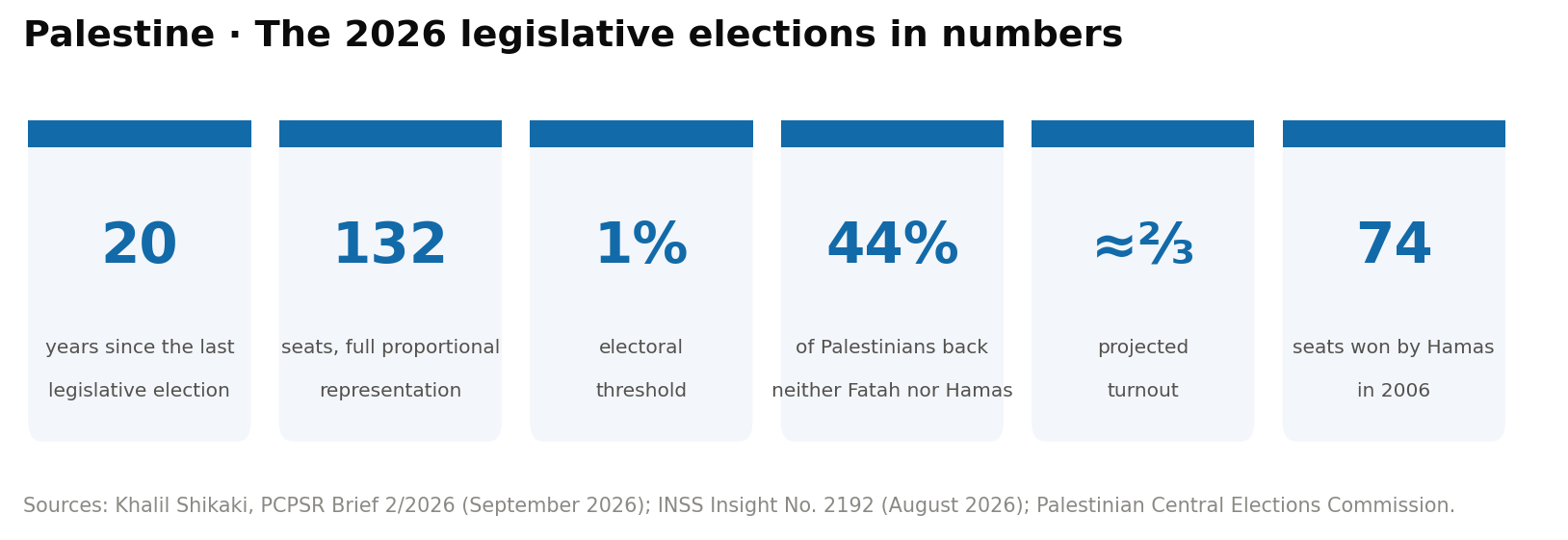
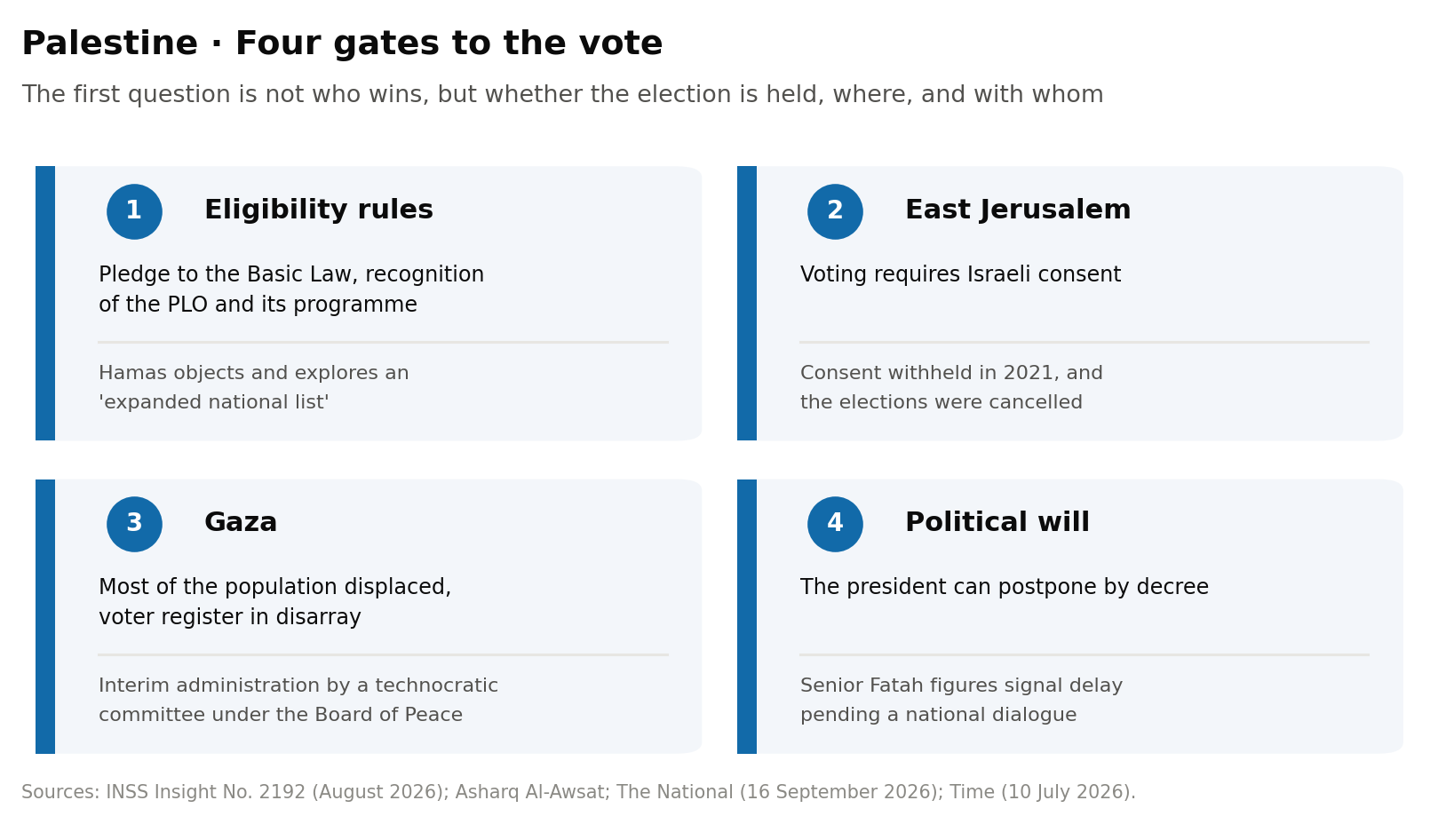
The central dilemma lies in the rules of eligibility. Under the amended law, every candidate must pledge to respect the Basic Law, to recognise the PLO as the sole legitimate representative of the Palestinian people and to abide by its political programme, which entails recognition of Israel and the renunciation of violence.[4][5] The conditions are meant to ensure that the vote does not produce an authority that disowns the Oslo commitments. Fatah insists on them, with Arab and international backing, while Hamas sees them as negating the very purpose of an election.[5] Two forms of legitimacy collide here. Procedural legitimacy demands adherence to the existing contractual framework, while representative legitimacy demands a council that reflects the actual balance of forces in society. Reconciling the two is precisely what the Palestinian political system failed to do after 2006.
Hamas is seeking to circumvent the dilemma rather than confront it. Talks in Cairo are exploring an "expanded national list" that could join Hamas with Islamic Jihad, the Popular Front, Mohammed Dahlan's current and independents, with individual candidates signing the pledge while the movement itself remains unbound by it.[4][6] Israeli research institutes read this as a route to legitimising the movement without disarming it, recalling 2006, when Hamas won 74 of the 132 seats.[4] Either way, outside actors will judge the result by who enters the council rather than by the integrity of the ballot.
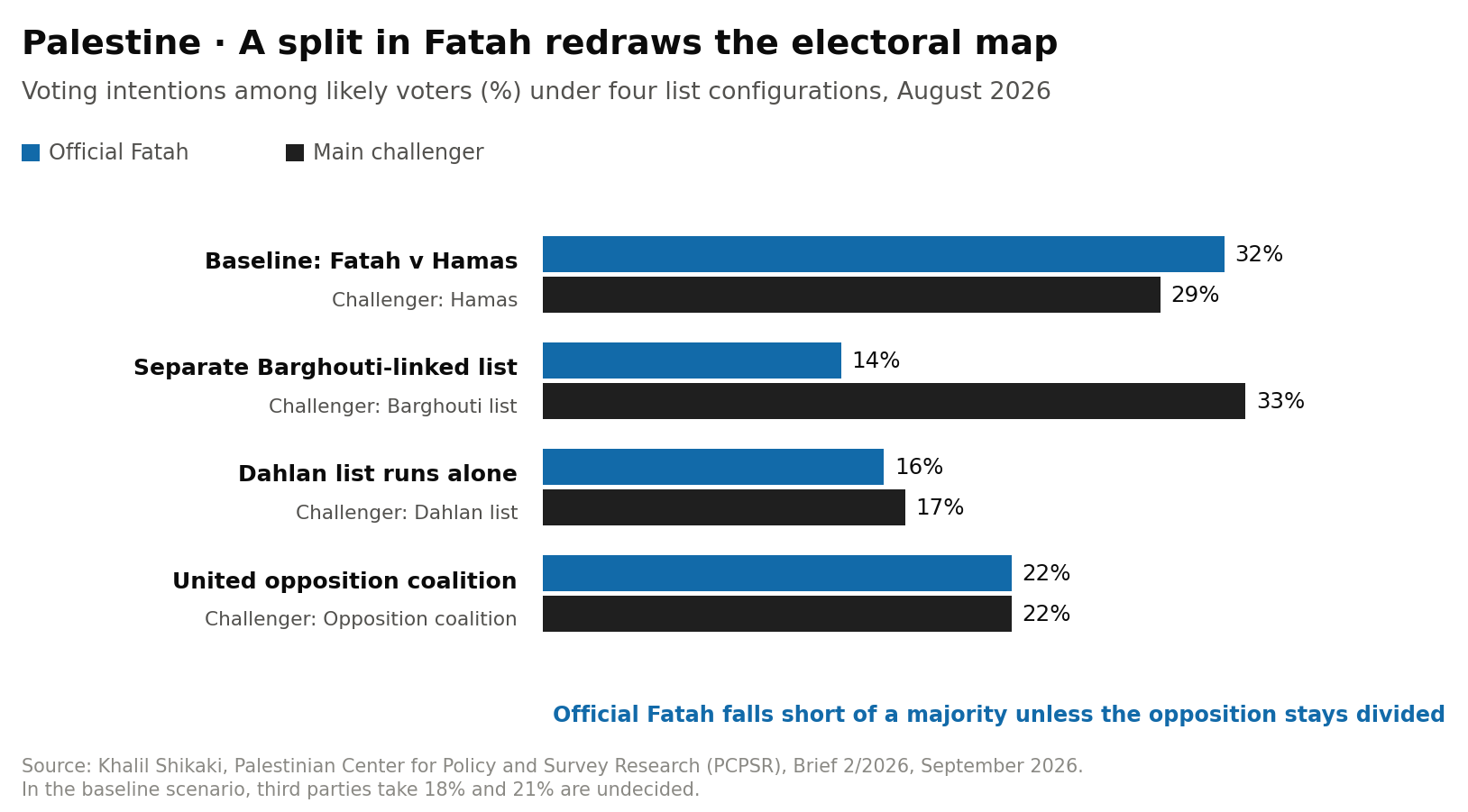
The Fatah–Hamas binary obscures the more significant shift, a crisis of renewal within Fatah itself. Data from the Palestinian Center for Policy and Survey Research show the two movements running close together, at 32 and 29 per cent among likely voters, with 44 per cent of Palestinians backing neither. More striking still, a separate list associated with Marwan Barghouti could take 33 per cent against 14 per cent for official Fatah.[3] Barghouti remains the most popular Palestinian political figure in PCPSR polling. He has been held by Israel since 2002 and is serving five life sentences following his conviction in 2004 by an Israeli court whose jurisdiction he refused to recognise. He has been in solitary confinement since October 2023. The election may become a referendum on renewing the national leadership rather than a contest between two projects.
Whether the election will take place at all remains uncertain. Voting in East Jerusalem requires Israeli consent, and the absence of that consent was the reason given for cancelling the 2021 elections. In Gaza, most of the population is displaced and the voter register is in disarray.[2] Senior Fatah figures have also signalled that the date will not hold without a comprehensive national dialogue.[6] The conditions under which the vote is held will therefore matter as much as its results. The next council will be judged first on whether it was elected across the West Bank, East Jerusalem and Gaza by all segments of the electorate, and only then on how its seats are distributed.
Israel Between Decision and Management
Israel's first election since 7 October 2023 lays bare a contest over the nature of the state. Both main camps reject a Palestinian state, in step with a public mood in which 79 per cent of Jewish Israelis oppose one.[7] Their disagreement turns on the pace and instruments of control over the West Bank. The governing camp draws on the logic of "decision" set out by Bezalel Smotrich in 2017, which seeks to extinguish Palestinian national aspirations rather than manage them,[8] while the opposition led by Gadi Eisenkot leans towards "managing" or "shrinking" the conflict.[9] The difference is real in pace and cost, but not in direction of travel.
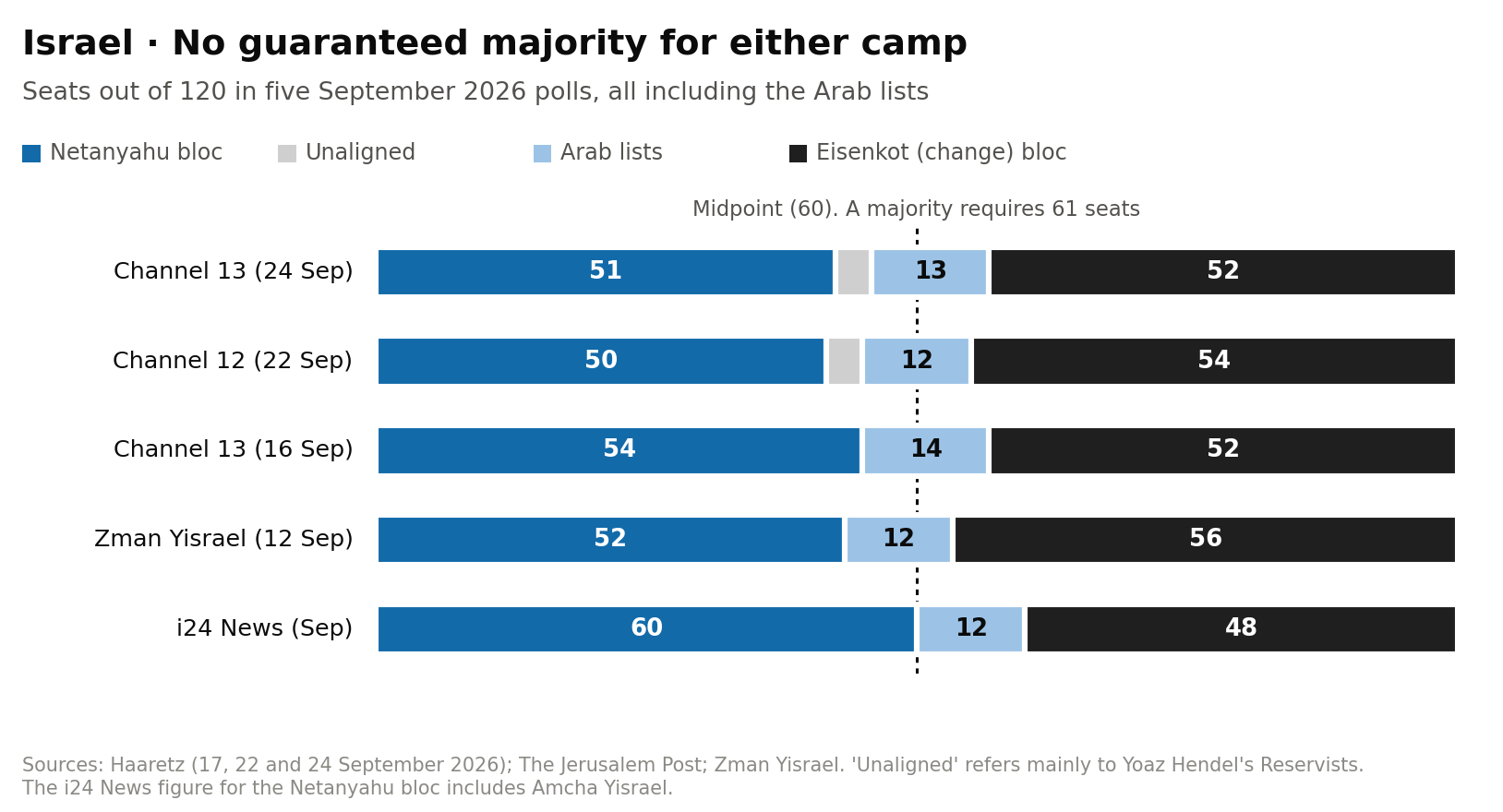
The polls show a fragile balance. A Channel 13 survey on 24 September gave the Eisenkot bloc 52 seats against 51 for the Netanyahu bloc, leaving government formation to post-election alliances rather than the vote itself.[10]
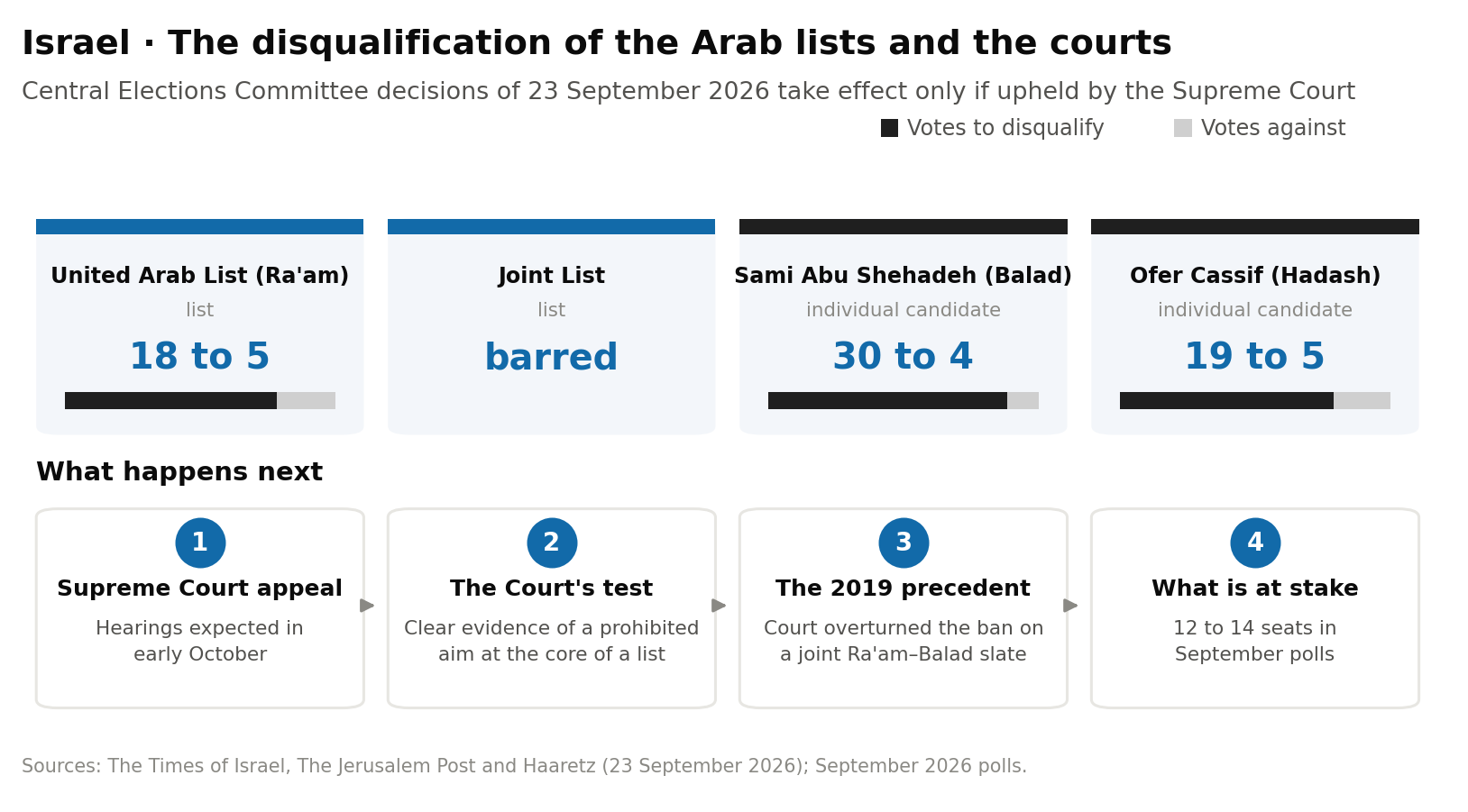
The disqualification of the two main Arab lists by the Central Elections Committee on 23 September reaches beyond coalition arithmetic, even though the decision takes effect only if the Supreme Court upholds it.[11] At stake is the political representation of Arab citizens, and with it the principle of democratic inclusion on which Article 2 of the EU–Israel Association Agreement rests. Palestinian representation is, strikingly, subject to eligibility constraints in both systems at once, in the Knesset and the Legislative Council alike, however different the justifications.
Washington and the Patronage of the Peace Process
Americans will vote on a domestic agenda, but the result will redraw the limits of action abroad. Polling averages give the Democrats their widest lead of the cycle,[12] and a Democratic House would subject the Board of Peace, hitherto a near-unilateral executive project, to legislative oversight of its funding and powers. The first signs came when Democrats on the House Foreign Affairs Committee challenged an attempt to transfer $50 million of State Department funds to the Board.[13]
Public opinion reflects a structural shift that will outlast this cycle. In February 2026, for the first time since Gallup began its annual measure in 2001, sympathy for the Palestinians (41 per cent) exceeded sympathy for the Israelis (36 per cent), driven by Democrats and independents.[14] The shift is sharpest among younger Americans. A majority of those aged 18 to 34 (53 per cent) now sympathise more with the Palestinians, against a record low of 23 per cent for the Israelis. Even among Republicans, favourable views of Israel fell 15 points in a year, to 69 per cent, their lowest level in over two decades.[14] The erosion extends to American Jews. In a June 2026 AP-NORC survey, 44 per cent of Jewish Americans viewed New York Mayor Zohran Mamdani favourably, against 32 per cent for Prime Minister Benjamin Netanyahu, and 30 per cent said Israel had committed genocide in Gaza. The bipartisan consensus that anchored US policy towards the region for decades is wearing thin, and generational change suggests the trend will deepen.
Intersections: The Logic of Mutual Effect
The analytical value of this moment lies in how each result redefines the others. Four intersections stand out.
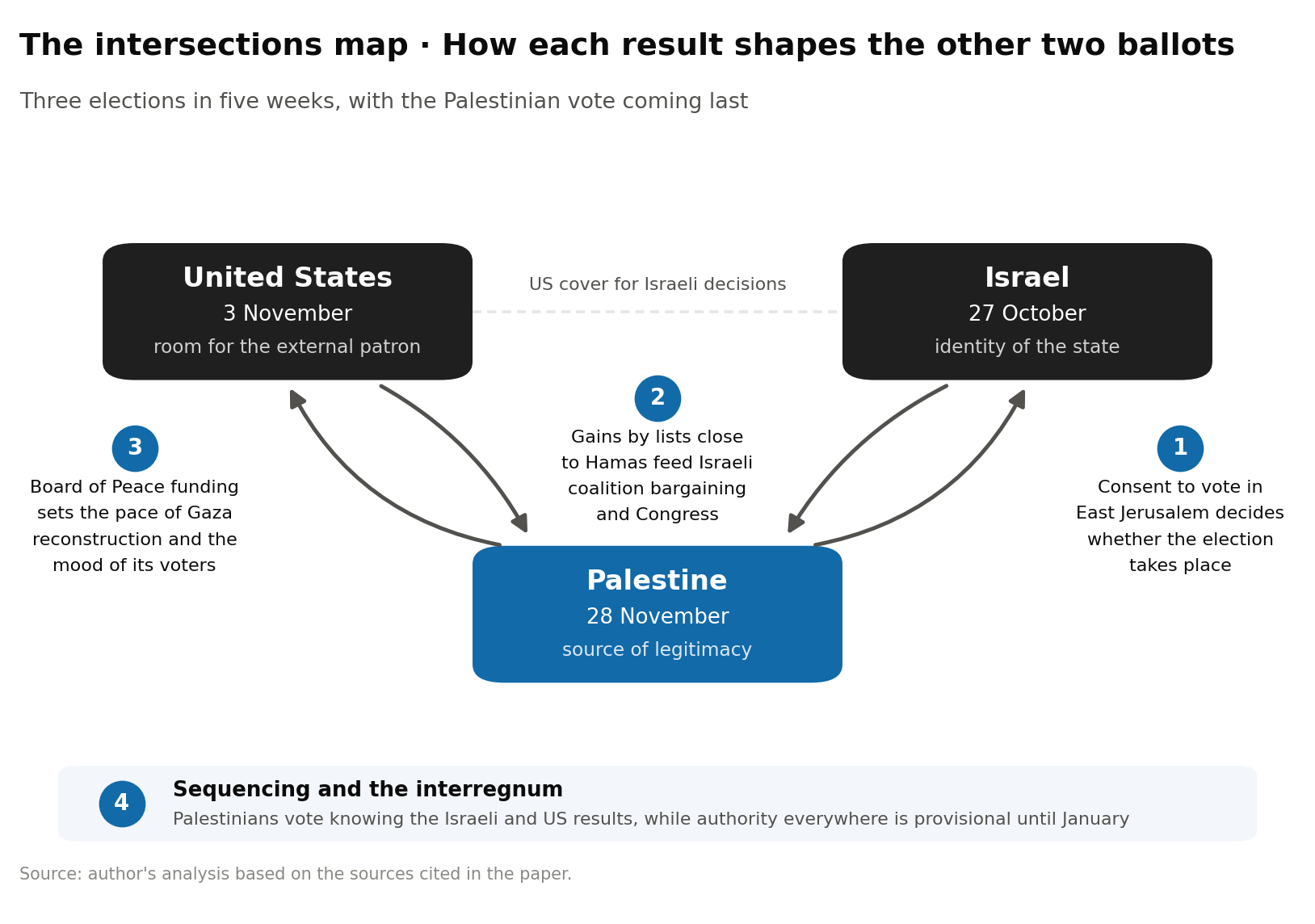
The first runs from the Israeli ballot to the Palestinian one. Voting in East Jerusalem requires Israeli consent, and the Palestinian leadership has made it a condition for holding the election at all. In April 2021, President Abbas postponed the entire vote on these grounds, declaring that there would be no elections without Jerusalem, after Israel said it could not take a position because it had not yet formed a government following its own election. The same configuration may recur. The next Israeli government, or a caretaker one, will decide on the Jerusalem vote, and the Palestinian leadership will then decide whether that answer justifies postponing the ballot everywhere. The Israeli vote thus shapes whether the Palestinian election is held, not only how it turns out.
The second runs from the Palestinian ballot to Israel and Washington. Any advance by lists close to Hamas would strengthen the case for decision in Israeli coalition bargaining and serve as a pretext in Congress for restricting funds to the PA. Here lies the paradox of legitimacy, in which a renewed Palestinian mandate may provoke reactions that weaken the very institutions it is meant to strengthen.
The third runs from Washington to Gaza. The makeup of Congress will set the level of oversight over the Board of Peace and its funding, and so the pace of reconstruction and the standing of the technocratic committee.
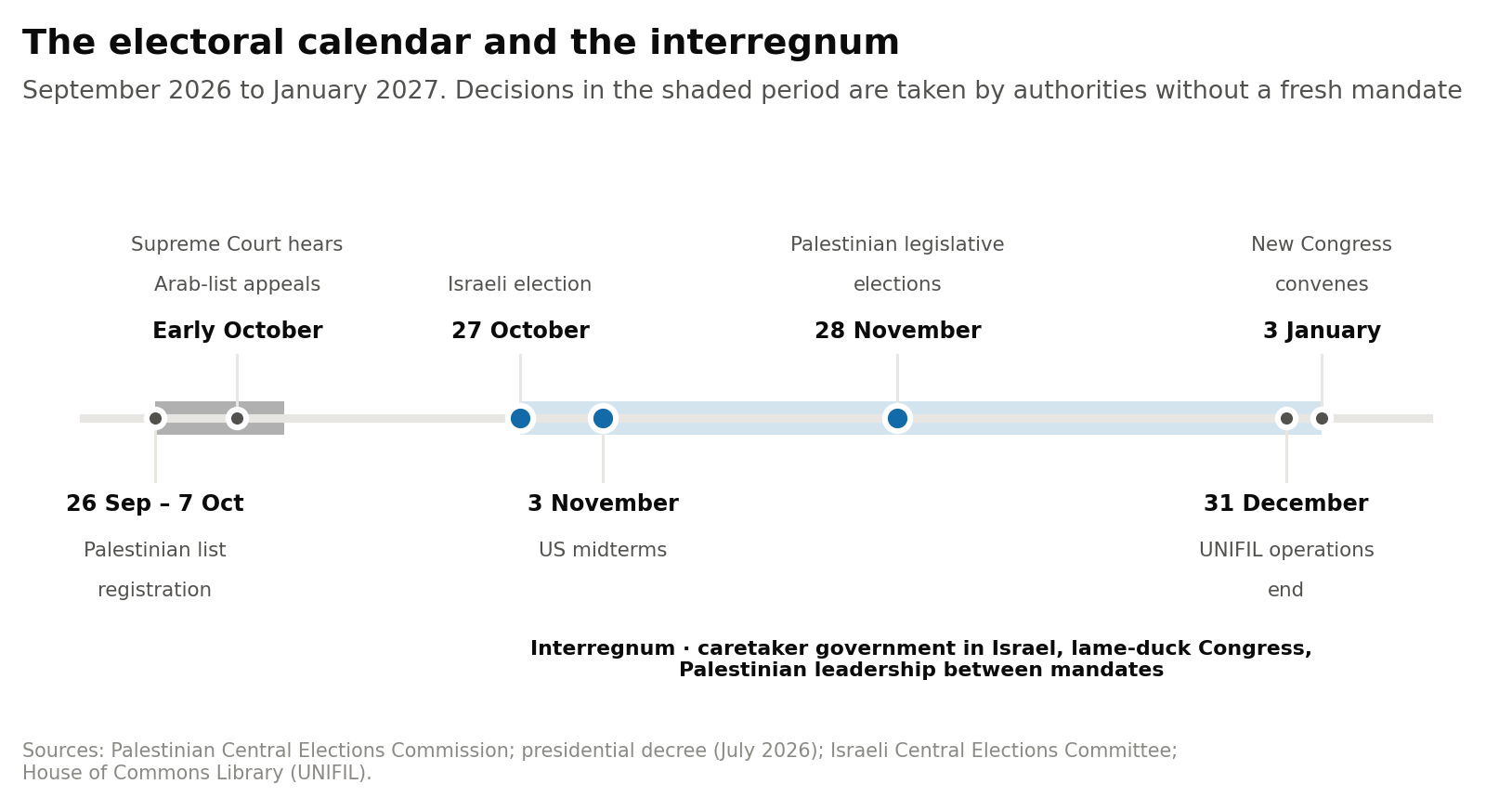
The fourth concerns sequencing and the interregnum. The Palestinian vote comes last, after the Israeli and US results are known, which leaves it most exposed to both and gives actors an incentive to delay or reposition. It coincides with a period in which authority is provisional everywhere, from a caretaker government in Israel to a lame-duck Congress and a Palestinian leadership between mandates, while UNIFIL's mission in southern Lebanon ends on 31 December.[15] Such periods tend to yield hard-to-reverse decisions, from settlement approvals to security deployments, taken without a fresh mandate.
Regional and International Actors as Mediators, Financiers and Veto Holders
Regional roles operate on three levels. First comes Egypt, the de facto electoral broker, which hosts factional talks and has reaffirmed its support for the Palestinian Authority, the two-state solution and national consensus. Jordan, as custodian of Jerusalem's holy sites, is a party to any arrangement for voting in the city.
Second, Saudi Arabia exercises what might be called a conditional regional veto. It ties any normalisation to the establishment of a Palestinian state on the 1967 lines, and Israeli analysts argue that reversing this position would require "political change in Israel".[16] The Israeli election thus becomes a variable in regional normalisation. Gulf and other Arab contributions to the Board of Peace, paid or pledged, buy influence over Gaza's governance that goes beyond finance.
Third, the war with Iran and the disruption of shipping through Hormuz have made Israeli choices part of the calculus of Gulf security and European energy security.[17] The Board of Peace has become an actor in its own right, with decisions concentrated in its chair, which explains the EU's reluctance to join.[18]
Three Possible Trajectories
A limited opening: An Israeli government closer to the logic of management permits voting in East Jerusalem, the Palestinian election is credible, and Congress tightens oversight of Gaza funding. Reconstruction and PA reform advance, but without a political horizon for statehood. Europe gains its widest scope for engagement here, and faces its subtlest risk. Functioning institutions and faster reconstruction may be read as progress towards peace, while sovereignty, borders and statehood remain untouched. Europe would need to treat these gains as a basis for reopening final-status questions, not as a substitute for them.
Colliding mandates: A government of decision faces a newly mandated Legislative Council that includes candidates close to Hamas. Steps towards formal annexation accelerate, and the EU faces a 2006-style dilemma between respecting the ballot and upholding its conditions for engagement.
A double vacuum: Government formation stalls in Israel and the Palestinian vote is postponed as UNIFIL withdraws. Decisive steps are taken without a mandate, escalation risks rise, and diplomacy loses purchase for want of a mandated interlocutor.
Europe: Ample Instruments, Scarce Resolve
The EU holds more leverage than its political presence suggests. It is Israel's largest trading partner, accounting for 31.7 per cent of Israel's trade in goods in 2025,[19] and one of the principal funders of the Palestinian Authority. Yet when it found indications in 2025 that Israel was in breach of Article 2 of the Association Agreement, the Council could not muster a qualified majority to suspend the trade provisions.[20] Its legal obligations are clearer than its politics. The International Court of Justice's 2024 Advisory Opinion requires states not to render aid or assistance in maintaining a presence in the occupied territory that the Court found unlawful,[21] and EU law requires settlement products to be labelled as such.[22] The Pact for the Mediterranean ties Europe's southern agenda to regional stability,[23] making this file a condition for wider European priorities.
Three options are open to the Union. The first is to wait for the new authorities to take shape, which looks prudent but cedes the interregnum to others. The second is to calibrate policy to particular results, which invites charges of electoral interference and collapses at the first surprise. The third is to anchor policy in legal obligations and measurable benchmarks applied to whatever authority the ballot produces. It is the costliest in internal consensus, yet the only option that holds across all three trajectories, because it measures conduct rather than the identity of the winner.
It requires the Council and the High Representative to adopt, before 27 October, benchmarks drawn from the Article 2 review and the ICJ Advisory Opinion, covering humanitarian access, settlement activity, settler violence and respect for the ceasefire, and to state in advance that caretaker decisions on settlement and annexation will be judged against them. The Commission and the EEAS should work with Israel and the Palestinian Authority alike to secure the conditions for a credible vote in East Jerusalem and Gaza, tie European support for the PA to verifiable reform, and seek a defined role in Gaza's reconstruction governance, with transparency safeguards for any funds channelled through the Board of Peace.
The European Parliament can play its part in the first quarter of 2027 through a trilateral parliamentary dialogue with the new Knesset, the newly elected Palestinian Legislative Council and the relevant committees of Congress, built on shared benchmarks that include electoral inclusion. Elections change governments. They do not change obligations.
References
- The National, 23 Sep 2026. https://www.thenationalnews.com/news/us/2026/09/23/board-of-peace-gaza/
- Time, 10 Jul 2026. https://time.com/article/2026/07/10/palestinian-authority-elections-gaza-west-bank-east-jerusalem-israel-explainer/
- Khalil Shikaki, PCPSR Brief 2/2026, Sep 2026. https://www.pcpsr.org/sites/default/files/Brief%202_2026_KS%20on%20Palestinian%20Nov%20Elections_English.pdf
- Ofer Guterman and Orit Perlov, INSS Insight No. 2192, 31 Aug 2026. https://www.inss.org.il/publication/hamas-pa-elections/
- Asharq Al-Awsat. https://english.aawsat.com/arab-world/5306933-how-will-hamas-handle-requirements-legislative-elections
- The National, 16 Sep 2026. https://www.thenationalnews.com/news/mena/2026/09/16/abbas-in-cairo-for-talks-with-el-sisi-as-palestinian-factions-manoeuvre-for-november-elections/
- Jerusalem Post, Nov 2025 (JCFA). https://www.jpost.com/israel-news/article-874235
- Bezalel Smotrich, "Israel's Decisive Plan", Hashiloach, 7 Sep 2017.
- Times of Israel, 27 Aug 2026. https://www.timesofisrael.com/eisenkot-says-two-state-solution-delusional-post-oct-7-but-e1-settlement-plan-a-mistake/
- Haaretz, 24 Sep 2026. https://www.haaretz.com/israel-news/elections/2026-09-24/ty-article/.premium/channel-13-news-poll-eisenkot-bloc-leads-with-52-seats-netanyahu-bloc-with-51/000001a0-cfc1-decb-affc-dfe9ca2f0000
- Times of Israel, 23 Sep 2026. https://www.timesofisrael.com/election-panel-votes-to-bar-balad-chief-abu-shehadeh-over-alleged-support-for-terror/
- Silver Bulletin, 2026 midterm forecast. https://www.natesilver.net/p/nate-silver-2026-midterm-election-polls-model
- House Foreign Affairs Committee Democrats, 25 Aug 2026. https://democrats-foreignaffairs.house.gov/2026/8/ranking-members-meeks-raskin-demand-accounting-of-trump-s-shadowy-board-of-peace-global-slush-fund
- Gallup, Feb 2026. https://news.gallup.com/poll/702440/israelis-no-longer-ahead-americans-middle-east-sympathies.aspx
- House of Commons Library, Jul 2026. https://commonslibrary.parliament.uk/research-briefings/cbp-10348/
- Yoel Guzansky, INSS, 23 Feb 2026. https://www.inss.org.il/publication/saudi-israel-2026/
- Brussels International Center, 21 May 2026. https://www.bic-rhr.com/research/the-impact-of-the-closure-of-the-strait-of-hormuz-on-europe
- Katarzyna Sidło, EUISS Commentary, 28 Jan 2026. https://www.iss.europa.eu/publications/commentary/board-peace-gaza-and-cost-being-inside-room
- European Commission, DG Trade. https://policy.trade.ec.europa.eu/eu-trade-relationships-country-and-region/countries-and-regions/israel_en
- European Relations, 27 Apr 2026. https://europeanrelations.com/briefing/why-the-eu-did-not-suspend-the-eu-israel-association-agreement/
- International Court of Justice, Advisory Opinion, 19 Jul 2024. https://www.icj-cij.org/case/186
- Court of Justice of the EU, Case C-363/18, 12 Nov 2019. https://curia.europa.eu/juris/liste.jsf?num=C-363/18
- European Commission and High Representative, JOIN(2025) 26, Oct 2025. https://eur-lex.europa.eu/legal-content/EN/TXT/?uri=CELEX:52025JC0026
Other Researches

